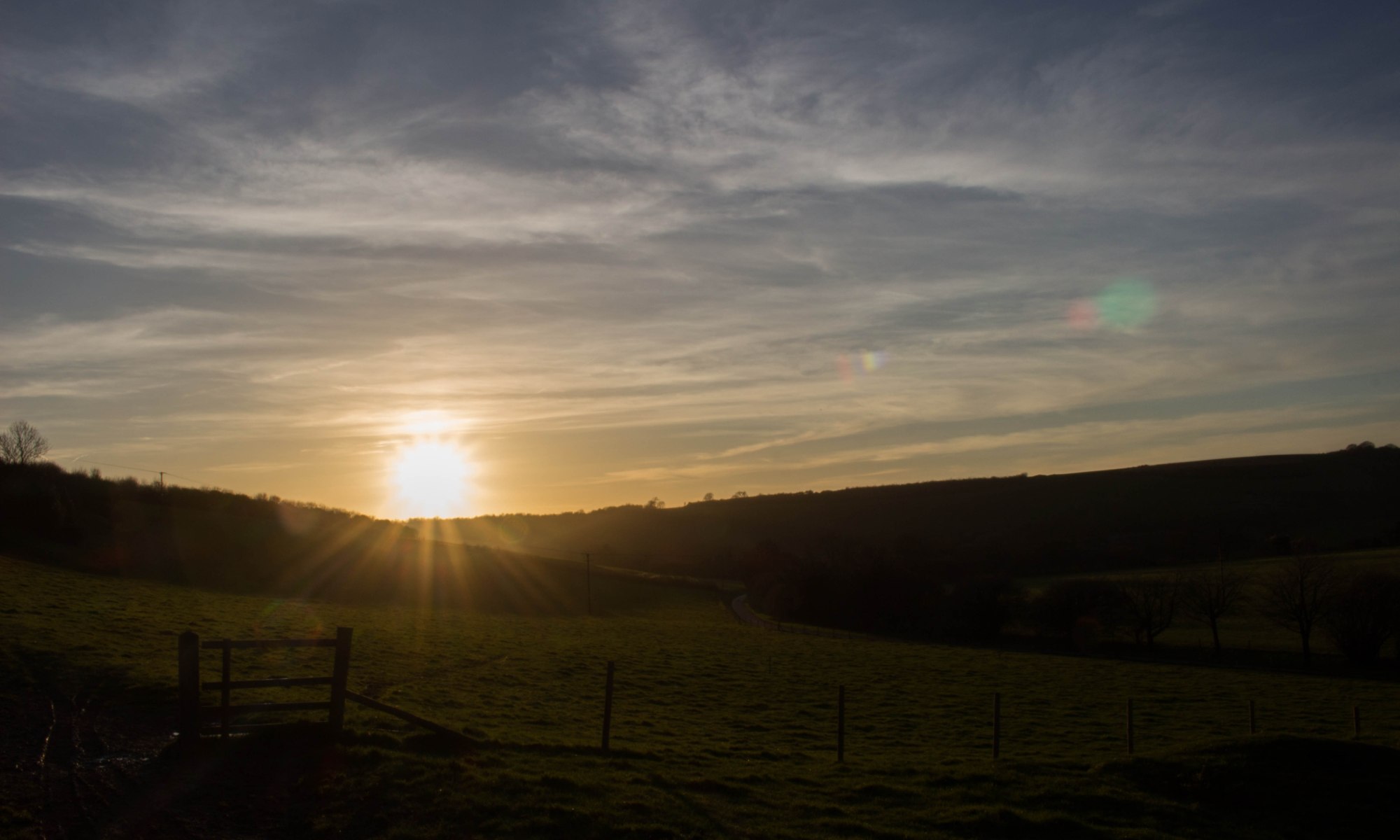
Henfield

On today’s walk I am, for once, actually in the Low Weald. Now, I have a tendency to think of the Low Weald as that bit of Sussex you have to drive across to get to more interesting places, but nevertheless off I set from Henfield down to the Adur (pronounced Ada) to see what I was missing out on. Which turns out to be badly waterlogged fields that proved once and for all that I need new boots. Again.

The Adur used to be navigable up as far as Knepp Castle (which is an interesting place in its own right), which always seems inconceivable considering how small the river is. Large vessels only ever came up as far as Steyning, though. These days they can’t get beyond Norfolk Bridge in Shoreham. The name of the river comes from the Roman fort Portus Adurni, which people in the 17th Century believed was in Shoreham. Turns out it was actually in Portchester, so only 37 miles out. Before it was called the Adur, it was known as the Bramber, after the village and castle, which is a much cuddlier name. Just to the west of Henfield the river divides into western and eastern branches, both of which remain tidal for some distance.

Also today I found some scary rogue ditches, the world’s most over-engineered bench and three cars that have been stuck end-on in the ground for some reason.

Droke

That morning I awoke with a feeling of complete uselessness. Nothing I had or could do seemed to have any meaning and the temptation to remain in bed, with the blinds closed and the only light provided by a laptop screen was strong upon me. “Ah.” I thought. “Another day of pointless existence, I see. I suppose I’d better get on with it.”

I forced myself to go to a place called Droke. I’d first found it years before while exploring West Sussex by car. It sits in a long dry valley of the Downs which runs parallel to where the steep northern edge of the long line of hills descends to the Low Weald. The name intrigued me, redolent as it is of some elemental Jansson-esque monster of the woods. In fact, the name turns out simply to mean “steep-sided valley”. This is a timeless, lost place high in a landscape that has never been able to support large amounts of human life. What villages and farms exist are few, small, scattered and achingly beautiful. Charlton Forest is just to the north and one of the largest areas of woodland in Sussex – leading up to the top of the north scarp of the Downs – and I’d wanted to explore it for years. I was in an ambivalent mood as I drove there. That feeling in the pit of my stomach of not really knowing what I was doing or why.

The feeling persisted as I walked through mile after mile of beech plantation, almost as mono-cultural as a stand of pine with just a muddle of bramble at the field layer, a few dark yews dotted about and the odd hazel at the edges. All of that changed at a medieval wood bank near the summit, after which I was suddenly in oak/ash woodland with a significant coppiced hazel under-storey, a fair amount of hawthorn and wild cherry filling it out and moss everywhere.


The top was muddy as all hell, but some fine views fading into the soft winter haze over towards Harting Down and the Surrey Hills made up for it. I was just beginning to really tire of slogging through the mud when all of a sudden the woodland ended and one of the most beautiful dry valleys in the Downs opened up at my feet. The sun came out and I stood and watched a buzzard wheeling against the sky above me. Through a parting in the trees I caught a sudden glimpse of Chanctonbury Ring away in the distance, almost back at Brighton and as I took it all in I thought to myself: “Ah yes. This is the point.”


The hill down to Upwaltham was steep and after spending 20 minutes or so poking around in the beautiful old church of nearly 900 years, I abandoned my original plan of walking over Upwaltham Hill and Selhurstpark Hill to get back to Droke and took the quicker route along the road, as the sun was now nearing the western horizon. The sound of gunfire filled the air as I walked along Droke Lane, the guns lined up with their dogs in the fields like so many waiting statues.

Dudwell Valley

Few villages in Sussex occupy a more enviable position than Burwash and its neighbour Burwash Weald sitting high up on one of the great east-west ridges of the eastern High Weald. In days past they must have been even more beautiful, before main roads and ranks of parked cars came along with all their ugly convenience. Burwash sits particularly prettily on its ridge and the buildings along the main road remain very handsome to this day. To the north runs the greatest of the three main rivers that run east to Rye Bay – the East Sussex Rother (not to be confused with the West Sussex Rother, itself a tributary of the Arun. Or the Yorkshire Rother, come to that). To the south is, to my mind, one of the most beautiful parts of the High Weald, if not of Sussex in general.

A small river, never much more than a large stream really, the Dudwell has nevertheless carved a deep, steep valley between the ridges occupied by the Burwashes to the north and Dallington and Brightling to the south. The acidity of the underlying sandstone is much in evidence here and many of the paths and tracks are bordered with hedges made of gorse. The impermeable layer of Wealden clay that covers it also makes its presence felt – the fields quickly becoming waterlogged and difficult to negotiate in wet weather.

The whole is covered with a patchwork of pasture and dense woodland, with many rushing, falling streams running among them. Scattered farms and oast houses perch on the hills and ridges between them, commanding wonderful views down the valley towards where the Dudwell finally reaches the Rother at Etchingham.

Harrow Hill

On their hundred-mile march from Winchester, the South Downs finally meet the sea at Brighton. Further east and the great, white ramparts of the Seven Sisters rear up and terminate in the tallest cliffs in the South East at Beachy Head. Further west, though, and the hills slowly pull away from the coast until even the dip-slope no longer reaches the shore. As they go, this gentler side of the Downs gains more space before finding itself cut off by the sea and the landscape becomes more complex as hills start to emerge, slowly carved out of the chalk by unimaginable amounts of water washing down from the melting glaciers. It is almost possible to stand on the top of the Downs and look over them, seeing the hills as islands in a great sea of meltwater.

From Chantry Post above Storrington you can see four of these hills. Furthest away to the east is Cissbury Ring, an enormous hill fort, then come Church Hill and Blackpatch Hill and finally Harrow Hill. The last of these is reputed to have been the last place in England occupied by fairies, but sadly it’s impossible to get close enough to check as there are no rights of way over it and one must be satisfied with merely walking around it.

There is much evidence of prehistoric life in these hills, with enclosures, cross dykes, strip-lynchets and hundreds of barrows all visible in the Downland turf. Before the Second World War, even more would have been visible, but the production of food in those desperate years became a need more pressing than the preservation of tumuli and much of the dip-slope was ploughed up for the first time, destroying an unknown amount of archaeology forever.

Lickfold

I admit I mainly wanted to walk in the Lickfold area because it’s got a funny name, but it also turns out to be in a really beautiful, rural part of Sussex.

Sitting in that bit of the county between Midhurst and Haslemere, it is comfortably within the boundary of the South Downs National Park, but this is not Downland. The bones of the earth, where they break through around here, are not white chalk, but sandstones that are far older than that. The great dark lump of Black Down looms in the distance, itself an outlier of the sandstone Surrey Hills, despite being the highest point in Sussex. The ground is spongy, sweet chestnut abounds in the woods and there are vast areas of commercial pine forest, while bracken fringes the edges of the woods and lanes. In fact this area, with its acid soils and rolling, thickly wooded hills, has much more in common with the High Weald than it does with the South Downs.

The villages are few and scattered and the houses often built out of the local stone, glowing honey-coloured in the weak December sun. This is one of the less-visited parts of the National Park and this is a big part of its glory. The paths are a little harder to follow in places, but still not difficult and there were some real moments of delicious solitude, while the surroundings alternated between deep, dark, secret woodland and wide open pastures.

There may be something in this business of choosing walks based on funny names after all. As a bonus the area also glories in the names “Dirty Bridge Barn” and “Dirty Bridge Field” (which is a wood, oddly). There didn’t seem to be an actual “Dirty Bridge”, though. Perhaps it’s too ashamed to bring attention to itself.
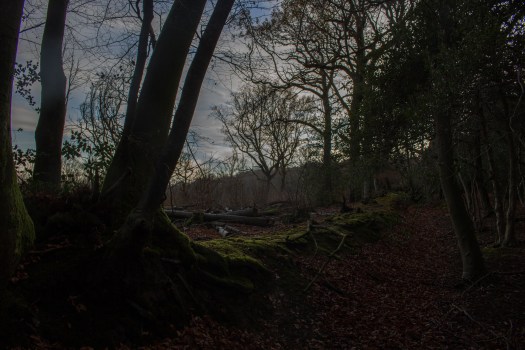
 

IMG_4410

A wood bank on the edge of Bexleyhill Common, with coppiced beech on the corner. Wood banks are ancient boundaries between properties and often have coppiced, stumped and pollarded trees on them to make them more obvious.

IMG_4417

Although this might look like a stand of dead trees, in fact it’s a plantation of larch – the only deciduous conifer – in its winter plumage.
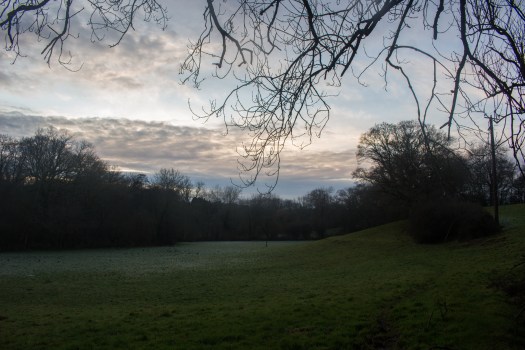
IMG_4423

Definite signs of man-made channels in this meadow, silted up and barely discernible now, but the shallow, linear depressions in the deep grass show that this was once a water meadow and deliberately flooded to encourage lush growth. Just needs a lovely old red poll cow called Ermintrude to stand in the middle of it all and chew on a buttercup. A red poll? In Sussex? Sorry, that’s the Suffolk in me coming out.
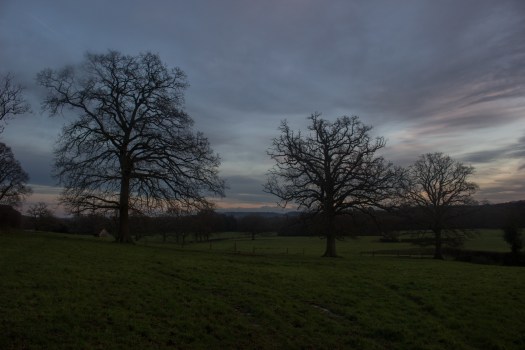
IMG_4424

If you see a row of big old trees in a field like this, it’s very likely a sign that there used to be a hedgerow here. The rest of it’s been grubbed up for one reason or an other and only the big old oaks, too expensive and valuable to remove, remain to show us what once was.
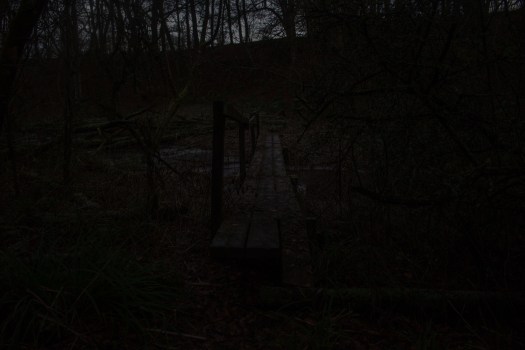
IMG_4428

Although it looked quite scary in the gathering gloom and it was a bit slippery in the ice, this bridge doesn’t even make the top five Scariest Sussex Footbridges

Stane Street

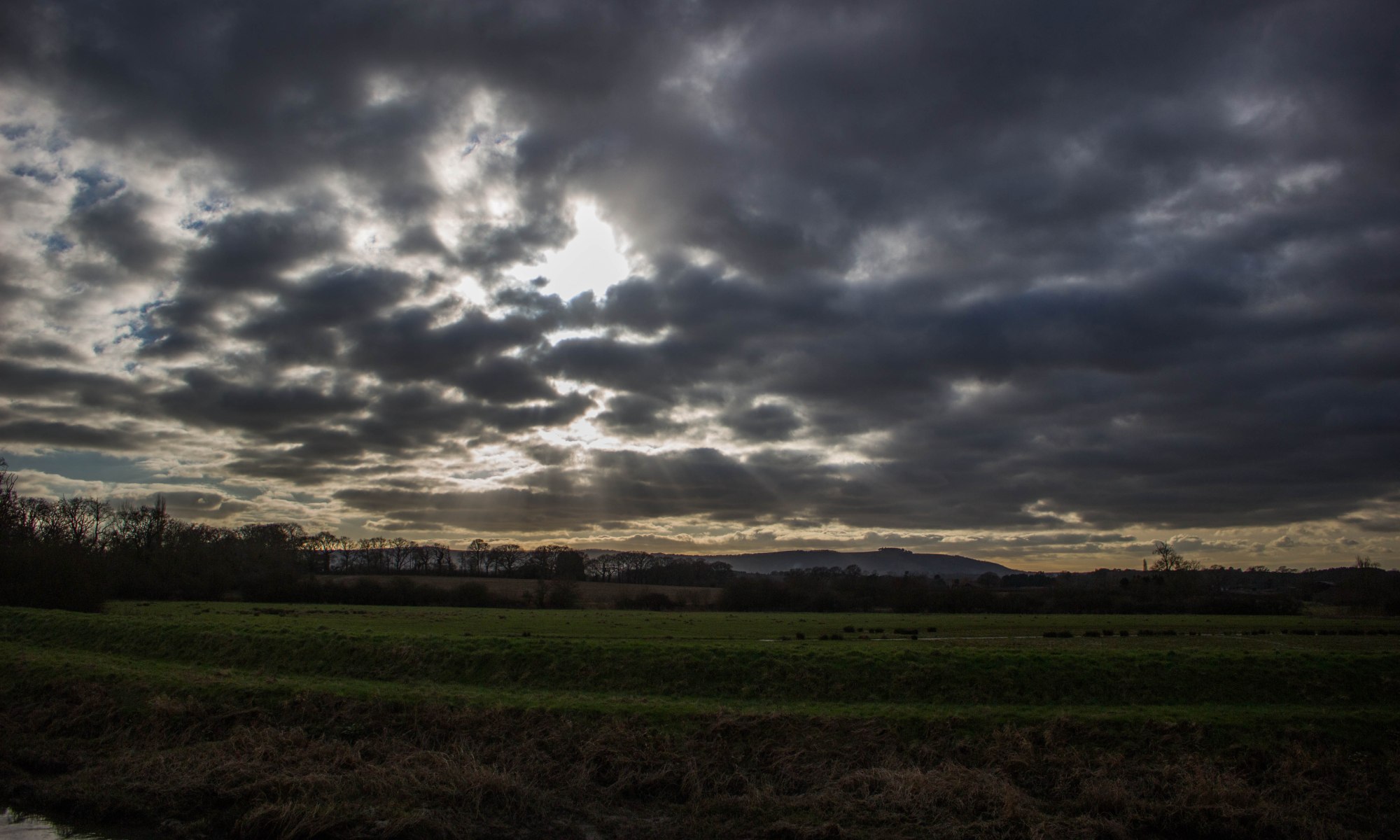
If you turn at the beautiful old farm at Bignor and drive up the narrow road onto the Downs, you will find a lane so steep and winding that you will be forced to change down into first gear to get the car up there. I have made this climb many times, both by car and on foot, but what I didn’t realise until yesterday was that as you make the second steep turn, you join Stane Street, the Roman Road from London Bridge to the East Gate of Chichester.

Not only that, but the “agger” of the old road itself can be clearly seen at the top of the hill, where the tarmac gives out, but the ancient route continues.

Now, I’ve been up to Bignor Hill dozens of times and I’d noticed this long, linear earthwork and, in my ignorance, had assumed that it must be some kind of medieval boundary marker. It was only a bit of idle map-perusal that led me to realise that this bank of earth was, in fact, built by Roman engineers nearly 2000 years ago!

So, of course, armed with this new knowledge I set off for a proper look. Eschewing my usual route along the edge of the scarp (which is beautiful), the old Road was easy to follow and, as it emerged from some trees it stretched so obviously ahead of me, towards Chichester I could scarcely believe it. As I walked back along the bank I’d seen before I couldn’t get over how clearly this was a road, now I’d seen it in the right way.

What a wonderful thing that a place one knows so well can turn out to have something so completely unexpected and exciting as this!

Gravetye Estate

What a find! The estate of the Elizabethan former manor house of 1598, the whole lot was left to the Forestry Commission on the death of former owner William Robinson, who also created renowned gardens around the house, which are now open under restrictions. The house became a hotel and Michelin starred restaurant.

Because the estate is managed by the Forestry Commission, the whole lot is designated as Access Land and the public have the right to roam across all of it. Unlike most Forestry Commission properties it is far from being uniform pine plantation, but is in fact a wonderful extensive patchwork of woods, fields, lakes and streams laid over rolling hills and with the old manor house still set at its heart.

Wester Ross

I have been to many beautiful places and there are those that equal, but none that surpass Wester Ross in the Scottish West Highlands for sheer beauty and grandeur. There may be bigger mountains in the world, the weather may be a bit tricky and the midges can be a challenge, but there’s nowhere quite like it. If you love walking in the hills, dramatic mountain and coastal scenery and some of the best seafood in the world, I urge you to go there.

A Few Extra

A collection of a few pics that, for one reason or another, weren’t part of other sets, or haven’t been posted before. Hover and click for descriptions.

Darwell Wood and Reservoir

The path fell steeply away at my feet as I entered Darwell Wood and I was quickly deep in the quiet, dreaming woodland. I could see on the map that I wasn’t far from the reservoir, but I couldn’t see it. My heart sank a little and I wondered if it would be the same as Weir Wood Reservoir, where only the barest glimpses of the water can be caught from the path and a high fence prevents getting any nearer. The path brought me to the long, gently winding incongruous sight of a covered conveyor belt, running through the trees: there are gypsum mines in these woods and the conveyor stretches for just under 5km between them. Turning away, the footpath drops once again and suddenly, to my delight, I could see the water through the trees. Fighting my way through dense willows, I emerged on the shore. What a beautiful place. I didn’t want to leave, but leave I did and looped back round through the woods to the car.