Oak

IMG_2129-3

Like a mouldering but still proud old man, Britain’s most famous tree species stands head and shoulders above all others in the national consciousness. The Oak is revered for its strength, its stature and its grizzled, gnarled permanence. From the earliest times, the Oak has been associated with the most powerful gods – with Zeus and Odin – its height – often bringing it in range of lightning strikes – brought it a strong connection with fire, as though its branches, reaching to the skies, were in communion with the very gods themselves. We can only wonder today at how the sight of a mighty Oak erupting in flame as a tempest raged about it must have impressed itself upon the imagination of the people who witnessed it – a people still utterly bound to the natural world, their lives inescapably entwined with the elements. When life and death were so easily at the mercy of these extraordinary forces, we can quite see how these great, powerful trees that stretched into the heavens can have taken on a godlike aura of their own.

Oaks are often known in folklore as the King of the Woods and its myths and personae seem unquestionably male, but in many ways the Oak can also be seen as a mother – a giver of life. No other tree of the British Isles supports such an array of living organisms as the Oak, from mosses and lichens, to insects and other invertebrates to the birds and small mammals that feed on them and ultimately to the higher predators that live on them in turn. Every tree is an ecosystem – a whole world in itself – and that can be no truer of any tree than the vast Oak.

In the 1st Century AD the great Roman historian Pliny the Elder wrote of a Ritual of Oak and Mistletoe that he reported was happening in Britain. Mistletoe was revered by the Celtic people who inhabited the islands and their druids; and none more so than that which grew on the Oak tree. With great ceremony the druids would climb the tree, cut the mistletoe with a golden sickle, throw it from the branches and catch it in a white cloak. Two white bulls would be sacrificed and an elixir made from the plant, which was believed to cure infertility and to counter the effects of poison. In ancient times, mistletoe was seen as magical because it remains green throughout the winter and its mere appearance – an alien lurking in the branches of its host – must have given it an air of great mystery and power.

As a mighty Oak ages, it often enters a “stag-headed” phase, where the highest branches die off and the crown of the tree moves down, the transportation within its vascular network thus becoming easier. As this happens, the circumference of the tree increases and its great girth begins to cause problems for the tree as a whole. The bark can no longer contain its bulk and it eventually splits, exposing the wood within to the elements. Soon, water finds its way in and the tree starts to rot. As the interior breaks down, the outer, living part of the tree then grows roots into itself and consumes the decomposing wood within. The heartwood having long-since died, the tree can sacrifice the strength it gives for its continued life. In the end this process leads to the outer part of the tree splitting into a ring of smaller trees but all still growing from the same old roots. In this way an Oak can live for many hundreds of years.

No other tree has been so extensively used in medieval building and in naval construction. The strength for which it was revered became inextricably linked with a vision of a powerful nation protected under its spreading boughs and still today, while protected from over-felling, it is a highly sought-after wood for many purposes, from framing houses, to building furniture and even to warming us as an excellent firewood. In the wheelwright’s workshop, it was used to make the spokes of a wheel, such was its straight, strong grain and its resilience under compression. From common people who were married under the boughs of Oak trees, to the the royals like Elizabeth who received news that she was Queen beneath one and Charles II who hid in one to evade capture as he escaped the country after Worcester, there is no tree that can rival its complete entanglement in the national imagination. This great living godlike plant is a portal both to the heavens and the vastness of the universe and to the tiny worlds of the minute creatures that inhabit its darker recesses. We would do well to retain the reverence our forebears had for this glorious tree.

Inadvertently Amusing Medieval Art

kellsmarygood

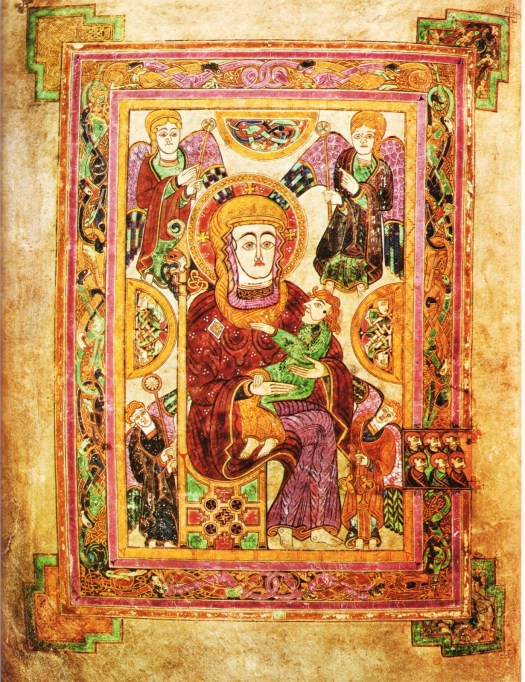
A real treat for you today. Probably my favourite inadvertently amusing medieval image of all time. The Book of Kells is one of the oldest and most richly-decorated examples of the Insular Art of the British Isles left to us. From the period popularly known as the Dark Ages (unless you are a historian, in which case that name is most definitely Not Popular), it is a remarkable survival of the Viking raids that were fashionable at the time. It is also hilarious.

Look how bored Mary is! “Oh gawd, I’ve been sat ‘ere ‘olding this oddly wizened old Baby Jesus for bleedin’ hours”, she seems to think. “Can we get this painting over with? I’ve got a dreadful cramp”. Then there’s the angels. The two up the top look particularly worried about something, especially the one top left who looks a bit like Joan Sims. Perhaps they are concerned about the fact their youthful Lord and Saviour bears more than a passing resemblance to Albert Steptoe. The lower angels are great as well, peering round her skirts and rolling their eyes and what the heckitty is the one on the right holding? Some kind of carpet beater?

The red-headed fellas with the enormous noses in the little panel are on the most boring day out ever somewhere, but at least they’re doing better than the alarming-looking knot of limbs and faces in the two semi-circular panels. But all that aside, I just keep returning to the look on Mary’s face, poor old girl. She’s completely zoned out now. Someone wake her up and make her a nice cup of tea.

Things I Have Learnt

“In 1848, at Nuneham House, a piece of Louis’ mummified heart, taken from his tomb and kept in a silver locket by Lord Harcourt, Archbishop of York, was shown to the Dean of Westminster, William Buckland, who ate it” – Source

I must confess that, when first I set forth upon the literary adventure afforded by this sentence, I was not expecting quite such a conclusion.

William Buckland, it turns out, was a palaeontologist given to lecturing from horseback in full academic gown. He coined the word “coprolite” for fossilised faeces and enjoyed the challenge of trying to eat as many different members of the animal kingdom as he could. He claimed that he least enjoyed eating moles and bluebottles. When presented with the heart of Louis XIV, he said he had never eaten anything so strange as the heart of a king, so he scoffed it.

In other news, my investigations into the life and career of Louis XIV have brought to my attention that one of his principle generals in the War of the Grand Alliance, Marshal de Luxembourg, looked an awful lot like Charles Hawtrey.

marshal_luxembourg
Oh, hello!

Wivelsfield – Burgess Hill. 12.55km (7.8 miles) Approx 4 hours

hedgetreesclouds

Hey! Hoi! Hupla! It is Spring! There are bluebells! It has, therefore, become essential to set forth on a jolly stroll so as to look at them. Now, my original plan had been to do my usual walk from Burgess Hill to Plumpton via Blackbrook Wood, but the good conductors of Southern Rail had other ideas and went on strike, rendering Plumpton Station inaccessible by train. Due to this unexpected happenstance, I was forced to change my intended route and settled on starting at Wivelsfield and ending at Burgess Hill, this route taking one also through West Wood on the way to Blackbrook Wood. I had never been to West Wood before and it turns out to be lovely and if it hadn’t been for the striking train conductors, I would never have found it, which just goes to show that collective organisation of the labour force has benefits throughout society.

Now then. First of all let’s get over any sniggering you may wish to do at the name “Wivelsfield”, no I’m not sure what a wivel is either, nor why one might want them felt, but let’s move on. Upon exiting the station, turn right on Leylands Road, if you’ve come from the Brighton direction, you will pass under the railway. Those coming from the Far North, like Haywards Heath or somewhere, will not get to experience this joy. Or at least, I suppose you could just pop through the bridge and back again if you really want to, but I’m not sure why you would if I’m honest. It’s a just a bog-standard railway bridge and wholly unremarkable. Proceed to the big junction you can see ahead of you and turn left onto Valebridge Road. After a little while there is a signed footpath on the right – the first that you will encounter. Follow this between the houses and straight ahead where it crosses a road until you cross a stile and into a meadow.

The path then heads slightly off to the left and is easy to follow. At the other side of the field, you pass through a gap in the hedge and then along the side of the next field with a hedge on a bank to your left, when I was there it was smothered with bluebells and stitchwort, which was rather lovely of it. We know how to tell the difference between English bluebells and Spanish ones, right? The flowers of English bluebells are all on on side of the stalk, making it bend over at the top in a charming fashion, while the brazen Spanish ones have flowers on all sides and, thus, stand upright in a most unseemly way. I mean, it’s not their fault they don’t know how to behave. Despite this obvious poor behaviour, they are beginning in places to out-compete and widely hybridize with their English compatriots and how you tell them apart I couldn’t venture to say. You’re probably best off throwing your copy of the Wild Flower Key at it and running off screaming.

Follow the path ahead which becomes a private road past Ote Hall, which is written in that fancy writing on the map that means it’s well old and posh and stuff. Where the road turns to the right, you will see a footpath straight ahead, which you should eschew, favouring instead one that turns half right and goes over a stile or through a gate or something, the path then sticking to the edge of the field on your right, marked by a hedge.

Now, I think we’ve come to that stage in life where we really need to have a little chat about hedges. In the old days, before my old Dad was born even, fences were a very uncommon sight on farms. “But how”, I hear you cry, aghast. “How did they control the livestock? Were the cattle and sheep running hither and yon, rubbing shoulders with the horses and causing mischief in the barley fields?” Why no, they were not. They were kept in place by hedges. Now, I don’t know if you’ve seen a cow, but I’m guessing you probably have. Big things, cows, as I’m sure you will agree. Hefty heifers and, erm, bulky bullocks. “How”, you may be given to wonder, “did the often spindly, gappy-looking hedges one sees about the place ever stop half a ton of beef from going anywhere?”.

The answer lies in the amount of labour available on the fields before the advent of mechanisation. Farms could often support dozens of workers in various roles and, during the winter when there was less to do on the arable fields, the hedges would be laid. The stems of the hedge plants would be partially sliced away on one side and then the whole plant pushed over to about a 45 degree angle. Hazel stakes cut from the woods would be hammered in upright along the length of and inside the hedge and the cut plants weaved through the posts, the tops of which would be bound with plaited thin hazel or willow withies. This created a hedge much thicker and stronger than one left to its own devices. Strong enough, even, to give a bull second thoughts – and bulls are fairly unlikely to have first thoughts, let alone second ones.

This thick hedge not only stopped beasts of the field from scattering willy nilly about the countryside; they also provided habitat for birdies and small mammals and wild flowers grew along their edges. They often linked areas of woodland, giving a corridor for wildlife to move across the landscape out of sight of predators, such as barn owls. Between the wars, however, the tractor and combine harvester came to farming and the workers weren’t needed. Huge farms could, for the first time, be run by a mere handful of people. A tractor with a mechanical augur on the back can drill holes in the ground and put a fence up in no time. No-one laid hedges any more and all the wildlife that depended on them is ebbing away from the countryside.

But what’s the difference between a hedge and a hedgerow? More on that later.

At the end of the field, the path goes around the right-hand end of Great Otehall Wood and then left with the wood on your left. You should now be in a long narrow field and the path leads diagonally across it to a footbridge over a stream. Cross the stream and follow the path ahead until you reach a road, which you head more or less straight across, the footpath slightly to the left of the one you’ve just left and obvious, leading down beside and fenced off from the grounds of a house, you will soon enter a scrubby bit of woodland. Of no great age for the most part, there is some older hornbeam coppice dotted about and a few older oaks that show every sign of growing in an open aspect, rather than in a woodland. Large trees that have grown in woodland tend to grow tall and straight to reach the sun, while those grown in the open are often shorter, but their branches spread out from much nearer to the ground, creating more of a domed shape. Turn left.

At the end of the wood, the path becomes a road in front of some beautiful old cottages. I had intended to take the second path on the right into West Wood, but I got a bit over-excited and turned right too soon at the first footpath and found myself in a field, so turned left there and followed the edge of the field until I went over a stile and onto the bridleway I had been intending to take. Turn right here, into the woods and follow it all the way through. I have no idea as to the ownership of this wood, but there were no signs saying “PRIVATE” and there were many clearly well-used paths through it, so… So long as you keep going in the same direction as the path, which follows the right-hand side of the wood you should be fine… What I will say about this wood, though, is it is truly beautiful and packed with ancient woodland indicators, as well as carpets of bluebells and anemones. Really lovely. You can find out more about how to spot ancient woodland in my post on that very subject here.

blackbluepath

At the end of the wood, you will be able to see fields through the thin band of trees you are now in to your left. Ignore a path off to your left that crosses the field, which came as something of a relief, as that path was hellishly muddy on the day I was there, and follow the path leading slightly to the right and stay in the trees. After a short while you will come to a track which you turn right onto, past houses. The track will bring you to a road, where you turn left and then immediately right and into Blackbrook Wood. There may well be cars parked at the entrance, which has a short wooden fence and a footpath sign.

Blackbrook Wood is one of my favourite woods in Sussex, bursting with ancient woodland indicators, like extensive hazel and hornbeam coppice, midland hawthorn, wild service tree, field maple, wood banks, stumped trees, lovely sinuous edges and, of course, more carpets of bluebells and anemones.

If you follow the main footpath through the wood, you will come to a gap in the woods with a gate leading into a field between Blackbrook Wood and another wood and giving a wonderful view of the Downs. Streat Hill is the highest point on the ridge that you can see. Follow the track (which is often very muddy here) on through the second wood. At the end of this track, if you turn right you are then in what is probably an assart hedgerow.

Aha. Ahahaha. Hedgerow. What’s the difference between a hedge and a hedgerow? Very simply, a hedgerow has trees in, which a hedge doesn’t. A hedge is generally a planted thing, often made up of all the same species, and tended in the way described above to make an impenetrable barrier. Hedgerows tend to be made up of many different species and include large trees. As a rule of thumb, the more woody species present in a hedgerow, the older it is. Each different species adds about a hundred years, so by counting the number of species it is possible to estimate the age of the hedgerow. In the case of assart hedgerows, though, these are remnants of older woods that have been left behind when fields have been cleared and may, therefore, constitute a thin strip of ancient woodland in their own right. This one has wonderful banks of primroses, bluebells, anemones, stitchwort and early purple orchids in the spring.

Return now back the way you came. Once you re-enter Blackbrook Wood after the gate with the view, do not on any account turn left on the first path down to a second track. Neither should you turn right along this track through more hornbeam coppice. You certainly shouldn’t follow this to a set of metal gates leading to a road, then turn right on a path that leads back into the woods and I can’t believe you’re even thinking of turning left at the end of that path and following another path back to the entrance you came into the woods by. Shame on you, this is private property and there are signs to say so.

blackblue

Once you emerge back onto the road, turn left and cross the end of Spatham Lane and follow the marked footpath on the other side. Follow the path along the right-hand side of a couple of fields and then right, through the gate on the other side, ignoring a bridleway leading off to the left of the gate. You will now be in a fenced-off path with cottages behind an apple-tree containing hedgerow on your right. Turn left over the stile after a short while and cross the large meadow, walking to the right of the trees on the middle of the field. Cross the railway line on a brick bridge and continue walking in much the same direction. The path should be discernible on the ground. There are wonderful, expansive views of the Downs here. You will end up in the corner of the field and through a metal gate onto a fairly busy road. Turn left across the front of a house and then right along a track opposite the house.

Follow the track ahead, which after some horse paddocks becomes a path through an area of fairly recently planed oak woodland and over a stile into a field, the right-hand edge of which you follow until you reach a private road, which you follow ahead. Straight over the next road and along the driveway of Weald House, just past the entrance of which you will see a stile into a field, with a water tower prominent. Climb the stile (or maybe it’s a gate, I can’t remember, but whatever) and turn left, down the hill, through the hedge, straight on across the next field, over a wooden footbridge through another hedge and over a stream, straight ahead again up the other side and you will come to the railway line, where you turn right and walk along the well-made path to Burgess Hill station.

Woodingdean – Lewes Approx 10.5 km (6.5 miles), about 3.5 hours

Castle Hill NNR
Castle Hill NNR

Now, try not to get too excited, but we’re back at that exceptional beauty spot The Downs Hotel in Woodingdean (served, excitingly, by both the No. 22 and the No. 2). I know it’s tempting, but try to resist its obvious charms. There’s a Tesco Express at the petrol station as well as a Co-op just over the junction, but if you can tear yourself away, turn left at the Downs Hotel and walk up the hill on Falmer Road. Just past the end of the buildings on the right is a small car park with a couple of tracks leading from it. The left-hand track is Drove Avenue, which becomes Jugg’s Road and is a popular and straightforward route to Lewes, but not a patch on my route (obviously), which goes through Castle Hill National Nature Reserve and has some of the best dip-slope/dry valley scenery on the South Downs.

Take the Left Hand Fork

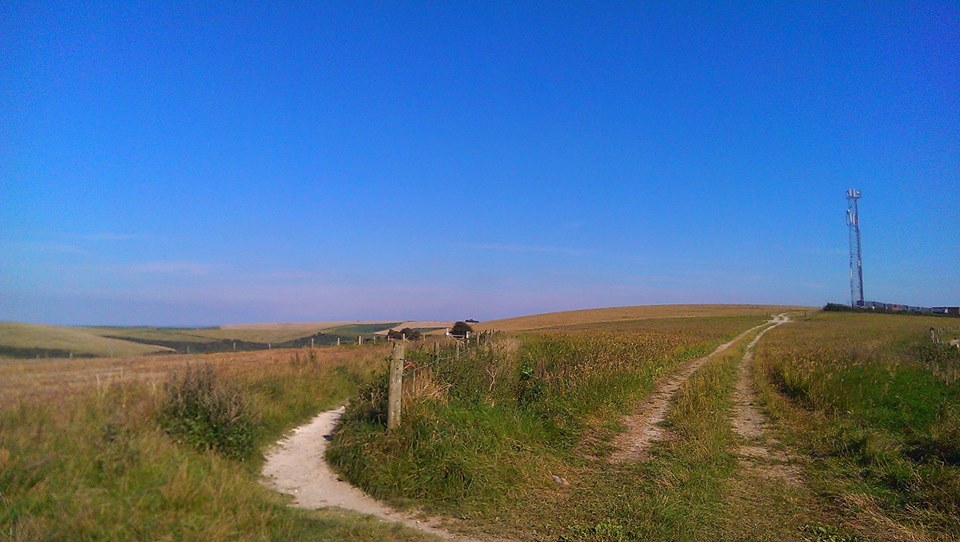
Follow the right-hand track, which I am sure you’ll be thrilled to know is called Norton Drive. Ahead of you, you will see a radio mast (you will also see, away to its left, another radio mast on the top of Newmarket Hill. So long as you’re heading initially towards the right hand of the two, you are going the right way. Well done!). Just before the radio mast, take the left-hand fork, with the fence on your right. This path, I have decided, is one of the most beautiful on the South Downs and I shall brook no argument on the matter. To your left is Newmarket Bottom and Bullock Hill rises on your right.

Follow the path all the way down and round to the right, round the end of Standean Bottom and back along the other side of the dry valley.

Have we talked about dry valleys? Let’s talk about dry valleys. The most famous dry valley on the South Downs is Devil’s Dyke and I’ll do a Devil’s Dyke walk at some point I’m sure, but the important thing is that they were all created in the same way, some 10,000 years ago, at the end of the last Glacial Maximum (or ice age, if you’re not being a ponce about these things, although technically, as there’s ice at the poles, we’re still in an ice age, but whatever). The Downs were not covered by glaciers (they only came as far south as North Finchley Tube Station), but they were frozen solid (There’s more on this guff in my post giving an exciting geological history of the Downs). As the tundra melted, the melt-water formed rivers in the dips and depressions on the Downs and eventually wore valleys into the surface of the chalk. Once the ground had all thawed, the water ran out and the rivers disappeared, leaving dry valleys behind. So now you know all about dry valleys. You’re welcome.

Barns
Barns

Anyhoo, you will now be walking along a track shaded by a slightly incongruous row of enormous London Plane trees. Be careful on this path, there are badger setts, some of the entrances to which are right in the middle of the path and perfect for unwary walkers to fall down. At the end of this path under a few big Ash trees, you will come to a junction of tracks, where you turn left, heading towards a collection of red-brick barns lacking somewhat in the roof department. Try as I might I have never been able to take a decent picture of them, but there’s always a certain glorious melancholy about ruined buildings, isn’t there? One day I will be there under the perfect conditions to take a picture that will capture that brooding melancholy of the abandoned… but I digress. Again. Sorry.

Just past the barns, turn right, go through a gate with a fence on your right, turn right at the end of the fence and then you should see a path leading off to your left along the length of this cultivated field. Through a gate at the other end of the field, across another fairly small field and through another gate into a much bigger field. Follow the path straight on and round to the right. This field may well be full of moo cows, but don’t worry, they’re friendly moo cows and used to walkers. Do keep dogs on a short lead, though. You are now in Balsdean Bottom, which is a great name for a bottom, I’m sure you’ll agree.

At the other end of this field you are presented with an exciting choice of gates, a new wooden one and and old, metal one. I like to go through the metal one, because I’m sentimental like that, but I shan’t be cross if you choose the wooden one, although I will silently judge you.

View from Swanborough Hill

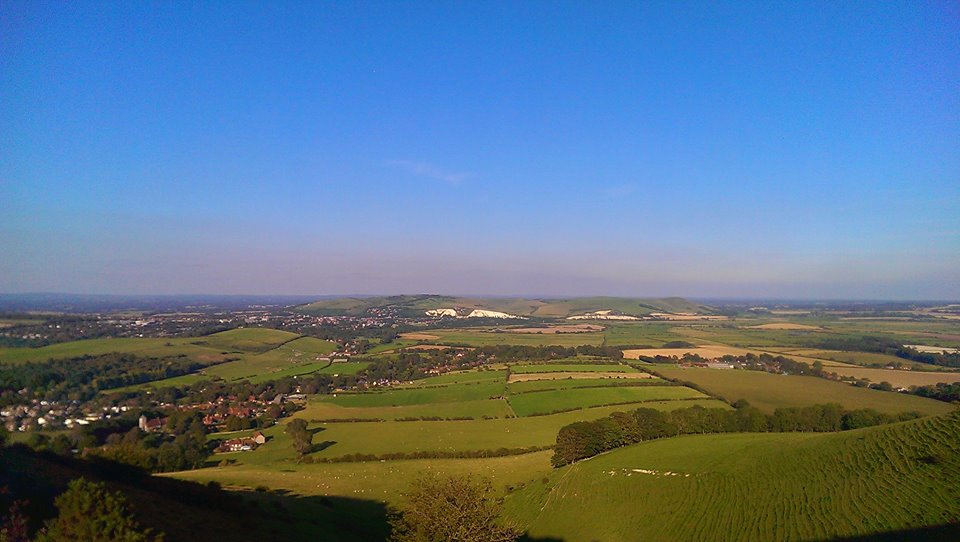
Follow the wide track straight ahead, which will start to go uphill. On your right is another valley that glories in the name of Stump Bottom, but pay it no mind. It does no good to encourage that sort of behaviour. At the top of the hill, cross a cattle grid and go straight on. You are now at the top of a shoulder of Swanborough Hill and all of East Sussex is laid out at your feet. The village of Kingston Near Lewes is at the foot of the hill. Dead ahead are the Lewes Downs, with the round, bald head of Mount Caburn at the southern extreme. The white cliffs are, imaginatively, called Cliffe, and the town to the left is Lewes, with its castle visible on its hill. I usually stop here for a roll up and a Double Decker and often find it hard to drag myself away from this view, which I regard as the finest in Sussex, even if you can see Kent in the distance. Try to ignore that misfortune.

Breach Road
Breach Road

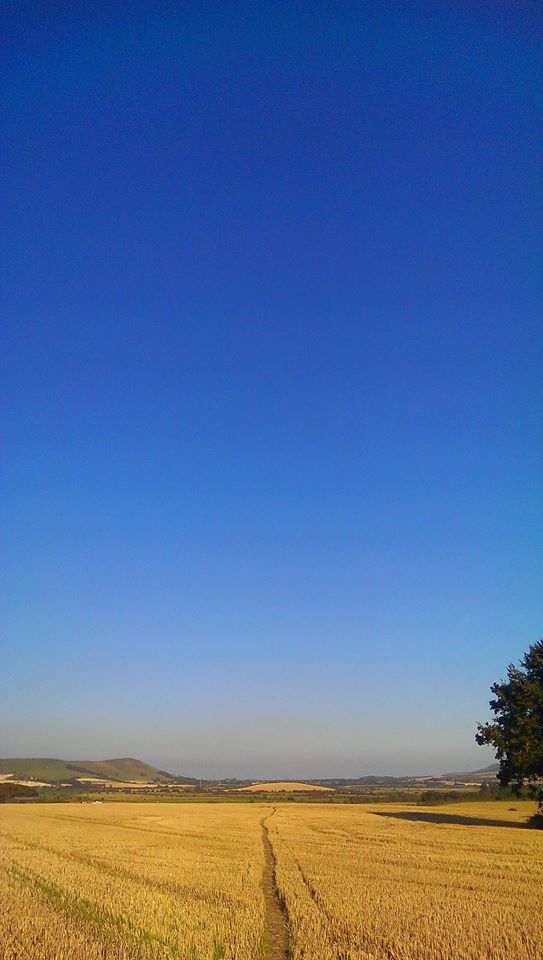
Leading down in front of you are two paths. One leads to the left and, very steeply, drops down to Kingston. You can go that way if you like. There’s a pub and everything. But it’s cheating, so I’m not going to describe it, so there. Take the right-hand fork, leading down and round a spur of the hills. This is Breach Road and leads, eventually, down to Swanborough, becoming metalled as it emerges from a small patch of trees. At the bottom of the road on your left is Swanborough Manor and the main Lewes – Newhaven road. Cross this carefully – it’s busy and fast here – and through a gate into wheat fields, the flat Ouse Valley suddenly around you. Take a moment as you cross this plain to look back at the hills you’ve just crossed.

Lewes Downs and the Ouse Valley

You will quickly come to a t-junction of paths in the middle of the field. Turn left and follow the path across the fields. There is a small airstrip to your right. At the end of the field, the path goes through a gate and down some steps to a tarmac lane. It may well be completely surrounded by tall nettles, but you can get through. Turn right onto the lane and almost immediately left, just before the gates to a sewage works up along and almost within a hedgerow.

Within a Hedgerow
Within a Hedgerow

At the end of this path you will come back out into a wide open crop field with the path obvious ahead of you. Cross the field and the next until you almost reach the road, then turn right with a large drainage dyke on your left, lined with tall trees and sports fields beyond. Follow the dyke (there’ll probably be swans and all that sort of caper) and at its end, turn left through a gate, across the end of a mown stretch of grass and through another gate onto a tarmac road. Turn right here and then left through a bridge under the A27. Follow the road round to the right, then turn left at the first junction. Follow this road under a low railway bridge and up to Southover High Street.

To get to Lewes railway station, turn right and left at the second mini-roundabout, but take my advice and explore Lewes and its many pubs, if you have time.